

Pillar Overview
Manufacturer digital self-service: the complete guide to B2B buyer portals.
Manufacturer digital self-service is the work of standing up a portal that lets dealers, distributors, and direct customers do what they used to phone the rep for. Reorder, check stock, request a quote, pay an invoice, see a contract price. The portals that succeed start with operational truth: pricing, accounts, approvals, and fulfillment mapped to the ERP before a platform is chosen.
The thesis
Self-service portals succeed when the underlying business logic, pricing, accounts, approvals, and fulfillment, is mapped before the platform is chosen.
What's in this guide
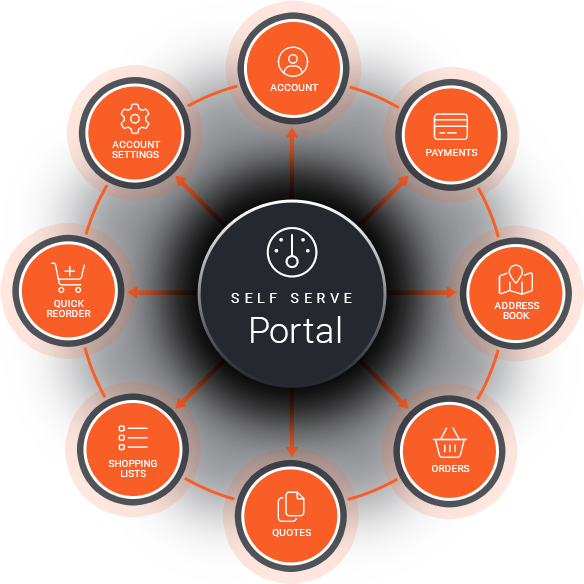
Seven Pieces, three decisions.
Skim by topic. Each section is grouped around a real decision that comes up in our portal work with manufacturers and distributors.
Next step
Get the foundation right before you build.
Celeste gives you an honest read on the architecture in about three minutes. Discovery and Strategy gets you the plan to execute against.
Manufacturer Digital Self-Service
Frequently Asked Questions
Manufacturer digital self-service is a buyer-facing portal that lets dealers, distributors, and direct customers handle the daily interactions they used to phone the rep for: reorders, stock checks, quote requests, contract-priced pricing, order status, invoice access, and CSR-assisted ordering. The eight workflows together form the working scope. Anything less and buyers route around the portal; more, and the project stalls before it ships.
Almost never. A modern manufacturer portal is an interface over the ERP, not a replacement for it. If the ERP can expose pricing, inventory, accounts, and order status through APIs, a portal can be built on top without an ERP replacement project. Pillar 4 has a dedicated piece on the ERP-keep path, and Acumatica customers in particular tend to find the integration ready out of the box.
For a focused first release covering reorder, stock visibility, and order status, a realistic window is four to six months from discovery to live. Quote-to-order, configure-price-quote, and contract approvals add another three to six months depending on ERP exposure. The faster timelines are the rollouts that picked a thin first slice and resisted scope creep.
Both work. Pre-built portals win on time-to-launch and on cost when the manufacturer's commercial logic matches the platform's assumptions. Custom builds win when the contract logic, account hierarchy, or configurator behaviour is too specific for an off-the-shelf platform to honour. Pillar 4 has a dedicated comparison piece with a decision framework. The honest answer for most mid-market manufacturers is a pre-built portal plus selective custom development for the irreducibly specific parts.
By making the portal the path of least resistance for the flows dealers do most, then giving the rep team tools to support the transition. Don't try to switch everyone at once. Start with the high-frequency dealers who already self-serve elsewhere, give them a reason to use the portal (faster status, saved carts, history), and let the rep channel handle the long tail. Pillar 4's dealer-reorder piece walks through the migration sequence.
The contract lives in the ERP. The portal calls the ERP at cart time, passes the buyer's account and the line items, and gets back the contract-adjusted price with the right effective dates and minimums applied. The portal displays the result; it doesn't compute it. That separation is what keeps quoted prices, ordered prices, and invoiced prices consistent across the portal, the rep tools, and the back office.
Call deflection by category, quote turnaround time, days-to-pay improvement, dealer adoption by tier, and contract attach rate are the five operating metrics that decide whether the portal is doing its job. Logins and adoption rate are useful as leading indicators but they're not the outcomes the project is funded for. Pillar 4's measurement piece has the full metric set with definitions and benchmarks.
An ecommerce site is built around acquisition: anonymous browsing, marketing-driven discovery, and a public catalogue. A B2B portal is built around the post-login workflows of identified buyers: contract pricing, accounts, approvals, AR, and rep collaboration. Many mid-market manufacturers run both, with the public site as the lead-generation surface and the portal as the daily-use tool for signed-in dealers and distributors.
Acumatica's distribution and manufacturing editions hold most of the operational truth a portal needs to call: customer-specific pricing, multi-warehouse availability, account structure, and order status. That makes the integration question shorter for Acumatica customers. Pillar 4 has two Acumatica field analyses showing the pattern in practice, and Pillar 3 maps the broader Acumatica commerce ecosystem.
Large accounts often buy through their own procurement system using punchout or EDI rather than logging in to the manufacturer's portal. The portal still has a role for those accounts as the rep-facing view and the source of truth for catalogue and pricing. The pattern that works is to treat the portal, punchout, and EDI as three buyer channels reading from the same ERP record.