

SHOPWARE + ACUMATICA INTEGRATION
Built for manufacturers who've outgrown generic connectors.
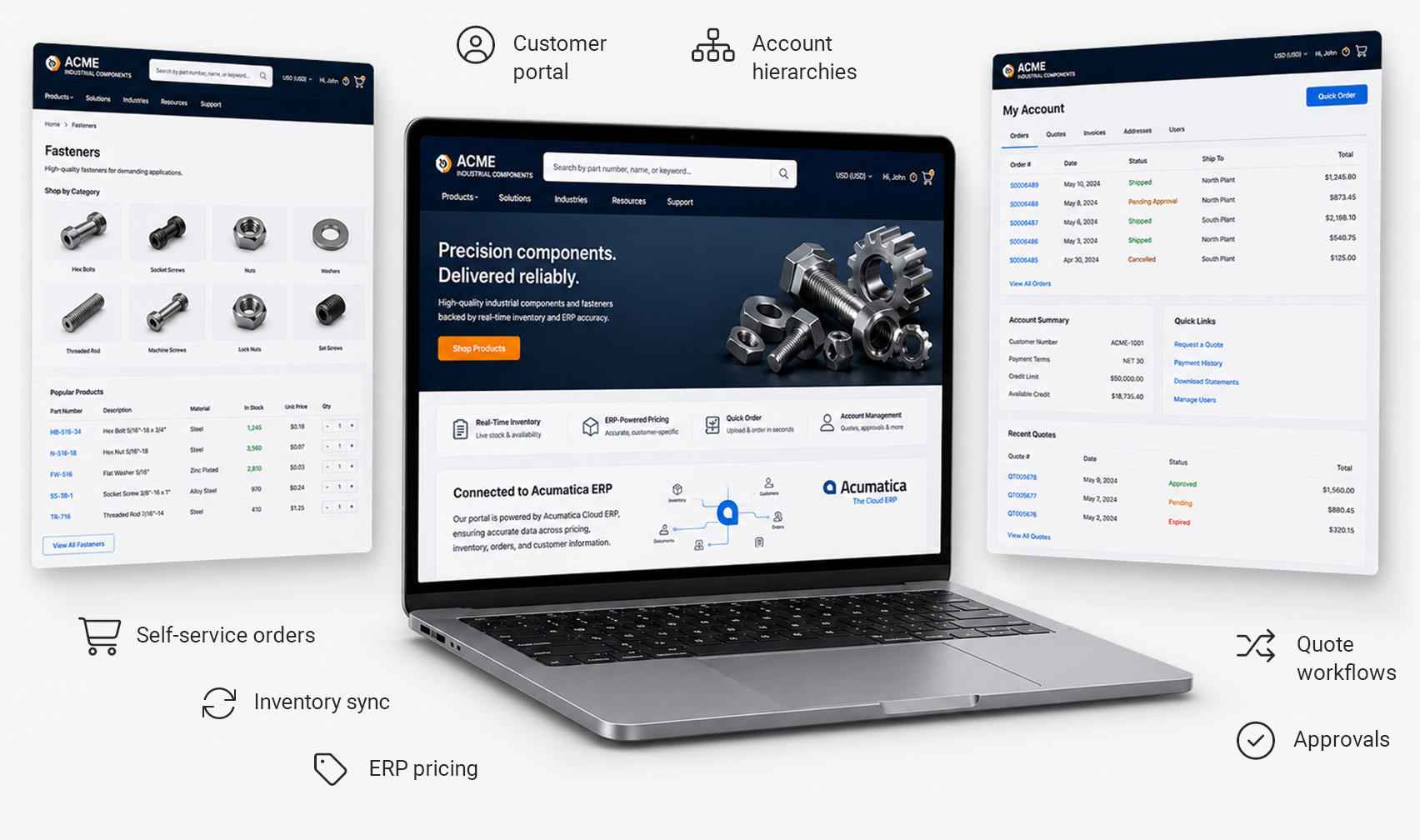
Acumatica + Shopware, integrated the way your business actually runs.
- Built for complex B2B commerce
- Addresses the workflows most connectors struggle with
- Early access for Acumatica customers and VARs
- Built and running, in its first manufacturer implementation
ARCHITECTURE BEFORE IMPLEMENTATION
The business comes first. The technology follows.
Every project starts by mapping your business logic against the integration architecture. You know what fits and what needs work before you commit.
- Built for the Acumatica ecosystem
Built in partnership with Acumatica VARs and tested against real manufacturing and distribution use cases. - Preflight pre-qualifies the fit
Our platform-fit AI maps your business logic against the integration before you commit — what fits, what needs work, where the risk lives. - 10,000+ SKU scale
Designed for industrial-scale catalogues. Built for the complexity manufacturers actually operate at, not proof-of-concept conditions.
Where Acumatica commerce connectors break
We spent the spring of 2026 auditing native ERP-to-storefront connector paths used in Acumatica B2B ecommerce implementations. We documented 10 hard architectural limits, including no real-time credit check at checkout, no field-level conflict resolution, and a documented volume ceiling above which the vendor recommends switching off real-time sync.
This is the part that breaks. This is what we are fixing first.
Shopware + Acumatica Connector Demo
Find the gaps after go live before you commit.
Schedule a 15-min screen share demo using a real Acumatica instance.
We'll show you what syncs today and review anything that might require additional configuration.
Why direct integrations keep failing
The generic ecommerce connectors that ship with most platforms weren’t designed for manufacturers selling different prices to different buyers through workflows shaped by contracts, approvals, territories, inventory rules, and ERP data.
That mismatch rarely breaks the demo. It shows up the morning after go-live, when the connector has to support the way the business actually sells. Three gaps, in particular, tend to show up first:
PRICING
Pricing lives in the ERP
Customer-specific prices, contract rates, Customer Price Classes, and volume breaks all belong in Acumatica. When a connector can’t surface them cleanly, the storefront starts drifting from the source of truth. Your team ends up checking orders manually, maintaining side lists, and explaining why the online price didn’t match the invoice.
ACCOUNTS
Your accounts are not flat
Manufacturers rarely sell to simple one-buyer accounts. Branch locations, approval hierarchies, sales-rep-managed accounts, department budgets, and buyer-specific permissions all shape how customers buy. When the connector can’t represent that structure, buyers route around the storefront and call your team instead.
SYNC
Sync is where the shortcuts show
Pricing, inventory, order status, shipping rules, tax logic, and customer data all need to move reliably between systems. A connector that looks fine in a controlled demo can start to strain once real order volume, exceptions, and ERP rules enter the picture. That’s when oversells, mismatched invoices, delayed updates, and manual cleanup begin.
Here's what syncs today.
Shopware + Acumatica, before and after integration.
Before the integration | After the integration | |
Inventory accuracy | Batch sync. Oversells happen. Customers get bad news after they’ve already paid. |
|
Manual order entry | Reps rekey web orders into the ERP, or a nightly job drops them in as a batch. |
|
Customer records drift | Two customer lists, two sources of truth, and a spreadsheet reconciling them. |
|
Payment status invisible in commerce | Finance knows the invoice is paid. The storefront doesn't. |
|
Catalogue scale | Variant limits and category-API transitions force trade-offs on real industrial catalogues. |
|
A record fails and nobody notices | A skipped record falls out of the sync window for good. Only a full manual resync finds it. |
|
Here's what syncs today.
Shopware + Acumatica, before and after integration.
| Before the integration |
Batch sync. Oversells happen. Customers get bad news after they’ve already paid.
| After the integration |
Delta sync every 15 minutes across the whole catalogue.
Acumatica's own endpoint only answers about one item at a time, so we built a date-filtered query that returns every stock change in a single call.
| Before the integration |
Reps rekey web orders into the ERP, or a nightly job drops them in as a batch.
| After the integration |
Orders post to Acumatica the moment they're placed.
Status, shipment, and tracking come back on a schedule.
| Before the integration |
Two customer lists, two sources of truth, and a spreadsheet reconciling them.
| After the integration |
Customers sync both ways.
New Shopware registrations write to Acumatica on save, and existing Acumatica customers import as business accounts.
| Before the integration |
Finance knows the invoice is paid. The storefront doesn't.
| After the integration |
Payment status flows from Acumatica into Shopware.
Transactions that don't confirm at checkout resync back once they're marked paid.
| Before the integration |
Variant limits and category-API transitions force trade-offs on real industrial catalogues.
| After the integration |
Designed for 10,000+ SKU catalogues of simple products.
Matrix items are the next build.
| Before the integration |
A skipped record falls out of the sync window for good. Only a full manual resync finds it.
| After the integration |
Every failed record retries automatically, up to three times.
Anything that exhausts its retries lands on an admin page with the reason, so going live doesn't need someone watching logs.
Here's what's next.
Shopware + Acumatica, integration roadmap.
| Where it stands today |
One base price per product, synced from the ERP. Every buyer sees the same number.
| What's coming |
Acumatica Customer Price Classes map to Shopware customer-group pricing.
The price a buyer sees is the price their contract already says.
| Where it stands today |
Simple products at industrial scale. Variant catalogues still get built by hand in Shopware.
| What's coming |
Matrix items sync as Shopware variants, structure intact.
The single hardest mapping in ERP commerce, and the reason the pipeline was proven on simple products first.
| Where it stands today |
An order reads as shipped once Acumatica reports a shipment against it.
| What's coming |
Per-line, per-shipment quantities map to Shopware's partially-shipped state.
A backordered line reads as backordered.
Also on the roadmap: sending partial payment captures back to finance, and Shopware's B2B hierarchies and approval workflows wired to Acumatica's account structure.
| Where it stands today |
Completed and Cancelled sync, because those two mean the same thing at every manufacturer.
| What's coming |
Awaiting payment, credit hold, and the states in between, mapped to the workflow your business actually runs.
| Where it stands today |
Credits are handled in Acumatica. The storefront doesn't reflect them.
| What's coming |
Credit memos and RMA flow through the same pipeline as the orders they reverse.
| Where it stands today |
The connection runs against one Acumatica tenant.
| What's coming |
Already built in.
A US and a Canadian tenant behind one storefront, connected through configuration rather than a second integration to maintain.
"We started by asking where the connector path falls apart. Where does pricing break? Where does inventory drift? Where do reps end up back in spreadsheets? Once you know that, the job is pretty clear. You build around those gaps instead of pretending the connector solved them."
Shawn McCabe - CTO, Acro Commerce
Built by people who understand ERP commerce
Acro Commerce has 28 years of B2B commerce architecture behind it. The team building this integration ships ERP-connected commerce for manufacturers and distributors, not generic storefronts or white-labelled connectors. Every deployment starts the same way: understand how the business actually prices, approves, fulfills, and supports customers, then make the platform fit that reality.
The business comes first. The technology follows.
| Architecture before implementation | Built for the Acumatica ecosystem | |
| Every project starts by mapping your business logic against the integration architecture. You know what fits and what needs work before you commit. | Built in partnership with Acumatica VARs. Focused on the B2B fundamentals manufacturers and distributors need from day one — customer-specific pricing, branch hierarchies, credit checks at the cart. | |
| Preflight pre-qualifies the fit | 10,000+ SKU scale | |
| Before the build begins, Preflight, our platform integration-fit agent for Acumatica, maps your business logic against the integration architecture and produces a written gap analysis, so you know what fits, what needs work, and where risk lives before you commit. | Designed for industrial-scale catalogues. Built for the complexity manufacturers actually operate at, not proof-of-concept conditions. |
Frequently asked questions
Native connectors handle the data every business shares: SKUs, descriptions, inventory, a base price. They're genuinely fine when your business fits that shape. They struggle when your pricing, approvals, and account structure carry logic the connector was never designed to represent. That's the part we build for.
Not yet. It's one of the gaps we documented in native connectors, and it's on our roadmap rather than in the build. If a credit hold at the cart is a hard requirement, say so up front.
Accounts, contacts, and addresses sync today. Multi-division hierarchies, department budgets, and approval workflows come from Shopware's B2B Suite, which we can add to a project. They aren't in the base connector.
Yes. Credit limits and AR balance are pulled from Acumatica and enforced in the cart before the order is placed — so over-limit orders don’t reach fulfilment in the first place.
It's built and running against a live Acumatica instance, and it's in its first manufacturer implementation now. We haven't cut a general release yet, so early access means a walkthrough and a conversation about your requirements, not a download link.
Yes. The first implementation is running with a manufacturer and their Acumatica VAR. We built the connector partly so VARs have something they can scope and sell without carrying the commerce risk themselves. If you run an Acumatica practice, talk to us about partner access.
There is now. Acro Commerce built one as a native Shopware 6 plugin, so it installs inside Shopware rather than running as separate middleware you license and monitor. Before this, an Acumatica and Shopware project meant a custom build or a third-party integration platform.
Middleware runs as a separate service between the two systems. You license it, host it, and someone has to watch it. A native integration installs inside Shopware as a plugin, so there's no extra service in the middle and no second subscription. The trade-off is that a plugin needs a Shopware plan that allows custom plugins, which a cloud starter tier doesn't.
Acro Commerce. We've built ERP-connected commerce for manufacturers and distributors since 1998, and we're a Shopware partner. The connector is our own plugin, maintained by our team.
SEE IT BEFORE YOU COMMIT
See what syncs, and what doesn't,
We'll walk you through the connector against a live Acumatica instance, show you what works today, and tell you where the gaps are. Acumatica customers and VARs get first access.
Are you an Acumatica VAR?
We built this for the channel to sell, scope, and support inside the practice you already run. The first implementation is live on a VAR-led account. Talk to us about partner access.