

Canadian data residency hosting
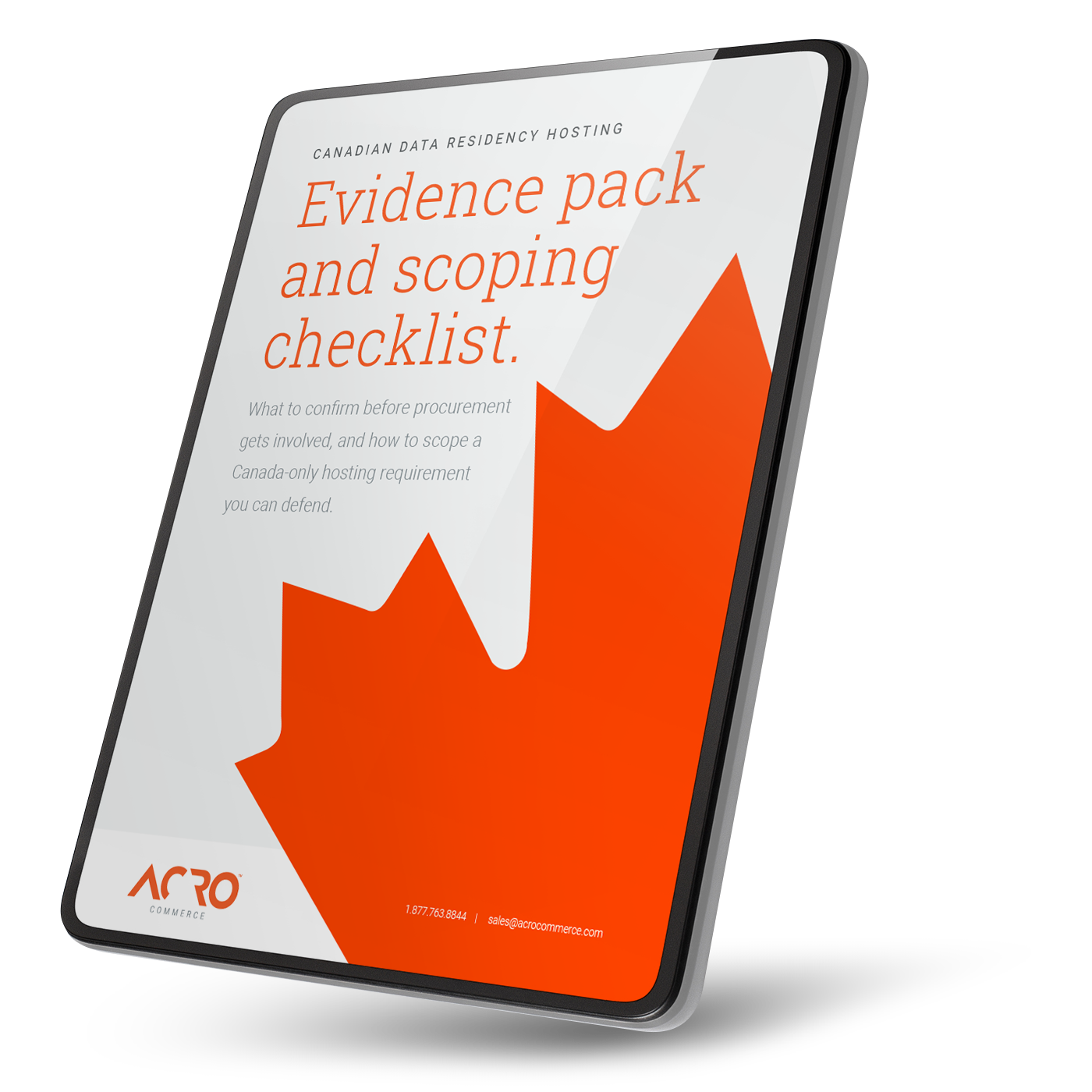
Can you answer the 13 residency questions your reviewers are about to ask?
If procurement, a customer, or a privacy officer is asking for Canada-only data residency, the questions arrive late and the deal stalls while you hunt for answers. This free kit gets you ahead of them.
- A residency scope statement template – you can fill in and circulate internally, so everyone points to one document.
- The 13-question reviewer checklist – covering storage, access, recovery, and the documentation reviewers always request.
- Residency vs. sovereignty, explained plainly – including what Canada-only hosting genuinely does not cover.
- A plain-language glossary – of FOIP, FIPPA, PHIPA, PIPEDA, and the recovery terms that show up in security questionnaires.
Managed hosting for Canadian orgnaizations like these





What's inside
Everything you need to scope the requirement, in one document
Most residency conversations stall because nobody has written down what's actually in scope. The kit gives you the language, the questions, and the definitions to settle that early.

- Residency scope statement
A fill-in template covering systems, data, required residency, driver, backups, and the evidence your reviewers will accept. - Where your data lives
A data-type-by-data-type breakdown: application services, databases, file storage, backups, and logs. - Shared responsibility model
Who owns what across the cloud platform, your hosting partner, and your own team. Reviewers expect this split in writing. - Controls summary
What turns a residency claim into something a reviewer can sign off on: region enforcement, access governance, change control. - Access and lawful access
The crux of “stored and accessed only in Canada,” addressed directly rather than dodged. - The 13-question checklist
Grouped by storage, access and governance, recovery and continuity, and documentation. Walk it before your reviewer does.
Why this comes up late
Most hosts can't answer the residency questions.
A hosting plan looks fine until a reviewer asks where the backups live and who can access them. That's usually deep into a deal cycle, and that's when things stall.
Typical commodity hosting
Acro Canadian data residency hosting
- Workloads restricted to Canadian Google Cloud regions
- Backups, snapshots, and recovery copies stay in Canada
- Privileged access controlled, MFA-enforced, and logged
- A clear, documented subprocessor posture
- Documentation organized the way reviewers think
Who this is for
Built for teams where residency questions are already shaping the deal.
Public sector and public bodies
Procurement that expects Canada-only data handling, written into the requirements.
Regulated and privacy-bound buyers
Teams navigating provincial privacy constraints and third-party risk requirements.
Audit and supply-chain obligations
Organizations with record-keeping duties, and manufacturers selling into regulated chains.
How residency is enforced
Controls you can show, not just claims you can make
Data residency is where data is stored at rest. Data sovereignty is who can compel access. Residency reduces cross-border exposure; it doesn't remove lawful access risk on its own. That's why we document the access pathways alongside the residency scope, and why the kit explains the difference before a reviewer raises it.
Region placement enforcement
Workloads are restricted to Canadian regions on a Kubernetes-based Google Cloud architecture.
Backups and disaster recovery in Canada
Snapshots and recovery copies stay in Canadian regions, including disaster recovery environments.
Administrative and support access governance
Privileged access is controlled, MFA-enforced, and auditable, with documented approval expectations.
Change control and monitoring
Residency-impacting configuration moves through controlled workflows to reduce drift over time.
Rather just talk it through?
Tell us the requirements you're facing and the systems in scope. We'll confirm whether this architecture matches what your reviewers expect, and what evidence they'll accept.
Just 20 minutes, no obligation.
Frequently Asked Questions
Questions reviewers ask first
Yes. No cost and no sales call required. Give us an email and we'll send the document. If you'd rather have a conversation, the 20-minute scoping call is there when you want it.
Data residency is where data is stored while at rest. Data sovereignty is who can compel access to it under applicable law. Residency reduces cross-border exposure but doesn't remove lawful access risk on its own, which is why the kit covers both.
We support Canadian data residency with enforced controls and reviewable documentation. Sovereignty includes operational access pathways, which we address through governance, transparency, and documented controls.
Sometimes. It depends on your operational access model and the evidence your reviewers will accept. The residency review is designed to confirm this early, before it costs you time.
Yes, when you select the Canada residency architecture. The scope statement makes this explicit, so there's no ambiguity for a reviewer.