



By Calvin Barrett
Posted in
March 13, 2024
The Sprint Don't Fall if the Scrum is Good | Article
AGILE PRINCIPLES IN ACTION
The Sprint Don't Fall if the Scrum is Good
At Acro Commerce, we have refined our processes to fit the Agile principles for software development. Why should that matter to your development project? Calvin Barrett, one of our developers, paints us a picture of how we use scrum, an agile framework, to make projects better and ensure we are getting the most done for our clients.
I’m currently in the deep freeze of a Prairie winter, looking at the ever-time-consuming task that causes me to doom scroll on my phone.
Not social media, but house hunting! It’s a game of cat and mouse, looking at homes, putting in bids, envisioning yourself moving into the house, and then being outbid. However, this has got me thinking about houses in the context of how we practice scrum here at Acro.
Thus, I figure it would be nice to meld my house-hunting habits with our scrum practice with analogies for a fun little comparison (or at least while these interest rates remain high).
Scrum: Epics, User Stories & Tasks
If you aren’t familiar with the term scrum, here is a brief definition from our friends at Atlassian:
“Scrum is an agile project management framework that helps teams structure and manage their work through a set of values, principles, and practices. Much like a rugby team (where it gets its name) training for the big game, scrum encourages teams to learn through experiences, self-organize while working on a problem, and reflect on their wins and losses to continuously improve.”
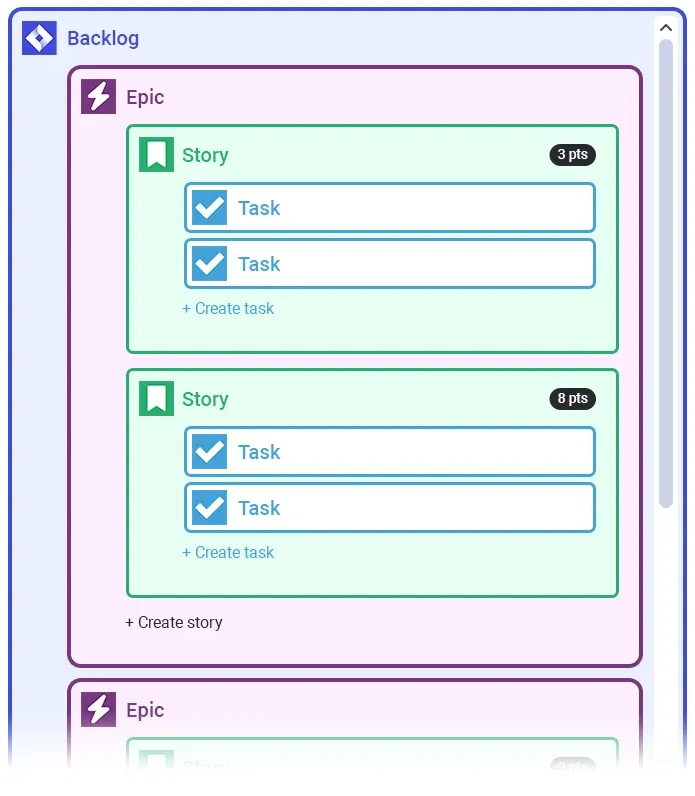
Using Jira, we organize the work that needs to be done in a project into epics, user stories and tasks.
Epic: Building a House
An epic in Scrum is like an overarching project or theme comparable to building a house. It's a large and complex piece of work that can be broken down into smaller, more manageable parts. For example, constructing the entire house involves various components like the foundation, walls, roof, plumbing, and electrical systems.
User Story: Constructing a Room
A user story is a more detailed and specific piece of work within an epic. It represents a distinct functionality or feature from the user's perspective. In our analogy, constructing a room within the house would be a user story. Each room may have its unique requirements, such as a bedroom needing a closet, bed, and lighting, but that room lives in the house, and so the user story for it lives in the house’s epic.
Task: Installing Light Fixtures in the Bedroom
Tasks are the smallest units of work and are associated with user stories. They represent the specific actions or steps needed to complete a user story. In our analogy, installing light fixtures in the bedroom would be a task associated with the user story of constructing the bedroom. This task is a tangible, actionable item that a team member can work on.
To summarize:
- Epic: Building a House (Large-scale initiative)
- User Story: Constructing a Room (Specific feature/functionality)
- Task: Installing Light Fixtures in the Bedroom (Specific action within a user story)
This breakdown helps organize and manage the development process, making it easier to prioritize, plan, and track progress in a Scrum environment. So now, much like Maren Morris states, “When the bones are good, the rest don’t matter… the house don't fall when the bones are good.” (I bet that’s stuck in your head now.)
I like to think that the “Sprint don’t fail if the scrum is good.”
Well, that’s all for now! To learn more about our agile principles at Acro, check out our video series here.
Our Agile-backed processes improve development project outcomes.
Visit our website to learn how, or contact us below.
