




By Freya Laskowski
Posted in
,
June 22, 2022
Is headless ecommerce right for your online store?
Is headless ecommerce right for your online store?
If you're familiar with the ecommerce market, you've probably heard about headless commerce technology, which helps businesses compete and become leaders in the online space. But, is it suitable for your company?
With headless technology, you can provide your clients with seamless digital experiences. More than 60% of businesses believe that headless commerce may dramatically enhance engagement and conversions.
With that in mind, this article will explain what headless commerce is, how it differs from traditional ecommerce, its advantages and disadvantages, and whether it is the best thing for your online store.
What is headless commerce?
For people unfamiliar with software or web development, the term "headless commerce" may be perplexing.
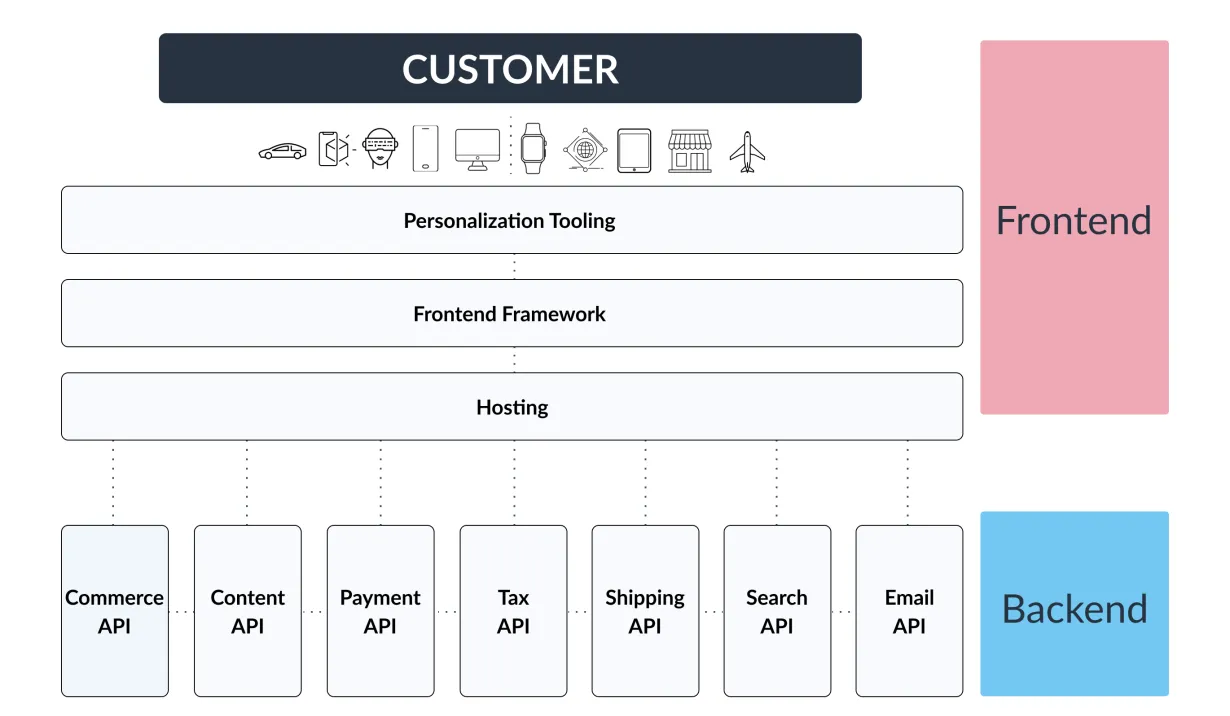
The phrase "head" or "front-end" refers to everything related to the customer-facing components of ecommerce. These components encompass digital interfaces, IoT, mobile platforms, social commerce, and similar technologies. In contrast, the back end is the underlying infrastructure that allows the application to function.
Separating the front and back ends is what headless commerce entails. This separation will enable you to make changes and updates to the front end separately from the back end (which is more complicated and costly to alter).
This type of decoupled structure allows organizations to build distinctive customer experiences flexibly and cost-effectively.
Architecture for headless commerce
A headless architecture is solely concerned with back-end processes. It separates the front end and makes the data available on many platforms via independent applications using APIs such as Mulesoft or Heroku. It also necessitates the usage of headless content management systems (CMS), which allow access to copy and image databases on the back end.
Payment processing platforms, customer relationship management (CRM) solutions, and multi-platform security systems are common back-end systems.
As a result, a coordinated and uniform experience is created, ensuring brand continuity and a seamless customer experience across numerous platforms.
Headless commerce vs. traditional commerce
Unlike headless architecture, most traditional commerce platforms have a monolithic-style architecture. The back-end system is coupled or inextricably linked to the front end. As a result, you may require some expertise in backend and frontend frameworks to guarantee they function correctly.
For example, if you want to change the check-out function or layout of your commerce platform, you must edit your database, code, and front-end. Because any changes or updates can damage the entire system, typical ecommerce stores have limited utility.
So, before we go into the advantages and disadvantages, let's first look at the differences between traditional and headless commerce.
Headless commerce vs. traditional commerce at a glance
| Area of concern | Traditional | Headless |
|---|---|---|
| Front-end developers |
|
|
| Individualization |
|
|
| Adaptability and flexibility |
|
|
Advantages of headless commerce
We learned the distinction between traditional and headless commerce platforms. Headless commerce provides greater capabilities for upgrading online stores as modern technology.
This section will go over the advantages of headless commerce for your business.
Provide a more personal experience
Headless technology enables merchants to create a consistent customer purchasing experience across several devices and platforms. Given the availability of backend user behaviour data, your ecommerce platform can provide a more tailored experience by indicating interests based on applications and other content management systems using headless.
Marketers can utilize customer data to create marketing campaigns that highlight special offers based on the user's activity. They can also integrate personalization into the overall purchase journey of the buyer.
Furthermore, developers are free from a linked front-end and back-end while developing the user experience in the headless structure. This decoupling enhances the capacity for customization and prepares the way for a more customized interface tailored to the customer's experience.
Expand brand exposure
Retailers no longer sell products and services just through their websites. Headless increases a store's exposure by bringing commerce to additional digital touchpoints. It introduces products and brands to potential clients who may have never heard of the merchant's website.
Customers may now interact with the company via any medium, including social network pages, smartwatches, linked automobiles, and others, and get a personalized experience on each. Potential customers can find products almost anywhere, ushering in a true omnichannel experience.
Headless improves agility & competitiveness
Merchants may update products and other information nearly instantly using headless platforms, without affecting the backend platform. Furthermore, companies can apply any modifications as soon as the need to change the user experience occurs or as products are improved, eliminating many pre-planning and scheduling delays. This improved workflow capability increases the platform's adaptability and allows retailers to keep up with rapid market developments.
Customer acquisition costs are low
The saturation of paid advertising is one of the primary causes of growing acquisition costs.
Consumers' expectations for content and purchasing experiences have grown due to their constant exposure to digital information and shopping experiences in a hyper-connected environment.
Brands have increased their competitiveness for client attention in paid advertising, driving them to spend more on sponsored advertising. Whether your store relies on organic search traffic or pay-per-click, the cost to attract and convert customers (CAC) rises year after year.
Online retailers may match consumer expectations of a seamless shopping experience by incorporating content marketing into the purchase journey. This strategy proves to be a more effective method of informing clients about the benefits of your products, building relationships, and driving demand. As a result, prospects will become loyal customers who return for repeat purchases, lowering your brand's customer acquisition costs.
SendInBlue, an email marketing platform, does this across their website. For example on their Bulk Email Service page, they seamlessly include a link to their blog, a pricing table, CTA, and a breakdown of features.

Higher conversion rates
Increased conversion rates directly result from the low client acquisition cost. By separating the front-end and back-end, retailers can more easily run a/b testing and other optimization tests, allowing them to identify the optimum approach to design and layout.
Headless allows you to discover which tools and designs clients prefer.
It removes the requirement for businesses to host their store on one domain and their blog on another, allowing them to integrate their consumers' digital experiences and deliver the same look and feel throughout the purchasing path. This streamlining eliminates any friction points along the buyer's journey that could affect conversion.
Improve your core web vitals
Adopting headless architecture improves SEO and increases page load speed in three ways:
- Traditional ecommerce platforms, such as Shopify, force you to rely on the server that hosts your commerce platform. When, for example, you utilize a US-based server while operating in Europe, this option is not best for your site's page performance. You can employ optimized servers for deployment with a headless solution to improve page delivery performance to the end-user.
- When online retailers seek a more personalized setup on typical ecommerce platforms, they add extra plugins. In the long run, this degrades page performance. Headless allows you to get the same level of customization with fewer plugins, reducing load time.
For example, Ozark Armament implements a headless solution on their website, which gives them the ability to have far better Page Speed scores, as seen below: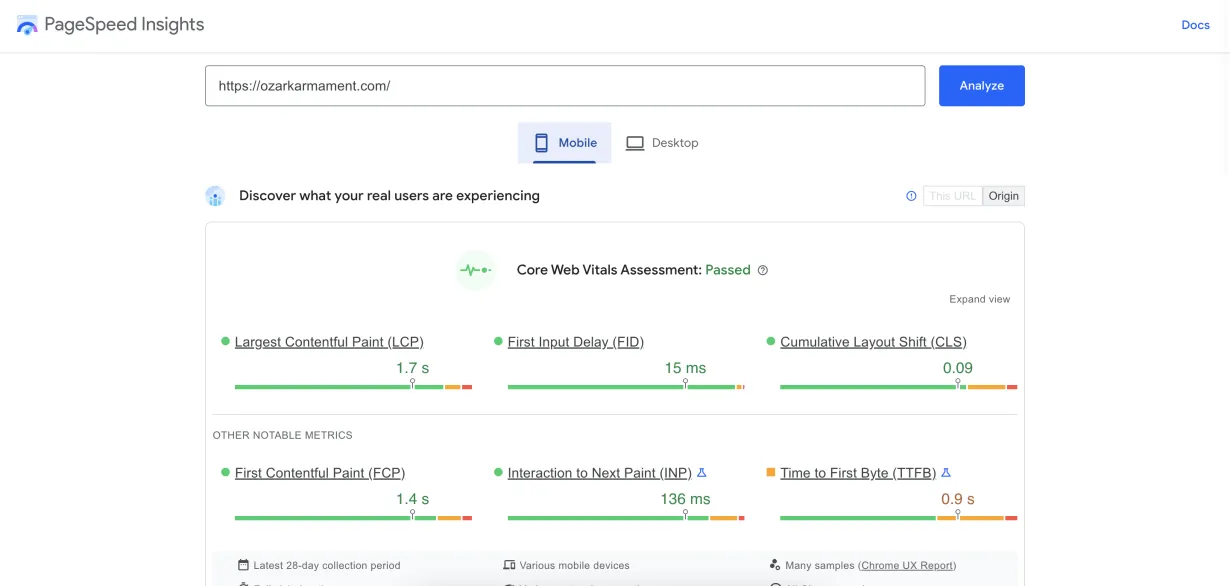
- Unlike typical website generators, which generate a page only when a user requests it, headless allows retailers to create static web pages (containing HTML, CSS, and frontend JS) that can serve straight on a CDN. A static site generator (SSG) improves page load time and significantly improves user experience.
Disadvantages of headless commerce
We've talked about how headless commerce can help you improve your customer's buying experience and grow your business.
Now, consider the disadvantages of using a headless ecommerce architecture:
The initial setup costs
The expense of deploying headless commerce in your online store is prohibitively expensive. Because your site's frontend and backend are separate, each needs its own development and upkeep. Furthermore, headless commerce solutions do not have a front end; thus, developers must create their own. This additional development can increase your site's total running costs.
Going headless is entirely dependent on the intricacy of your construction. The budget for an enterprise-level headless project could range between $50,000 and $500,000 (excluding maintenance costs). Where you fall in this spectrum is determined by the functionality, supporting tools, and level of customization you choose.
Headless incurs additional costs other than creating and deploying your sites, such as fees paid to external firms and monthly costs to CMS platforms.
Reliance on an in-house technical team
For brands that lack the in-house technical knowledge to run and maintain various tech stacks, headless commerce is difficult to maintain.
In the event of a problem, companies will have to rely on third-party external knowledge, making it an expensive alternative for small firms searching for a low-cost solution.
Time-consuming efforts
Continuous systemic updates are unavailable to brands using headless commerce architecture. While APIs are used to update typical ecommerce systems, this strategy does not work with headless. Headless is a high-maintenance, time-consuming, and expensive solution because of the lack of automated updates and security measures.
The steep learning curve
Headless commerce incurs the added expense of adding more management to the team; educating current team members to embrace the changes; or maintaining your online store's site for bugs, security, design templates, upgrades, and other troubleshooting issues with the assistance of professionals.
There are no performance guarantees
The usefulness of every website is influenced by two primary factors: speed and performance. While headless offers the promise of a fast site, it is not a guarantee. Whether you go headless or not, make sure your site is built by a team of quality-driven engineers and designers who understand the intricacies of constructing a high-performing site.
Not appropriate for newer ecommerce stores
Most businesses that go online require only basic ecommerce functionality at first: displaying products, enabling purchases, and receiving payment. Headless ecommerce would be more suitable if you wanted added benefits like including email marketing, a blog, opt-in forms, live support, and design functionality.
On the other hand, headless commerce is less suitable for brands that want to take their business online quickly because it takes time to align tech stacks and create workflows. As a result, brands seeking a standardized storefront may not benefit greatly from headless in their early stages.
Choose between headless and traditional
Using a typical commerce platform does not require high set-up fees and is simple to deploy. While components like frameworks, scripts, and templates can apply easily to traditional commerce platforms, they contribute to the limits of the platforms and prevent seamless digital experiences.
Traditional commerce applications have indeed grown to include state-of-the-art functionality. Still, many remain predominantly web-centric and less receptive to adapting to the new digital channels and devices.
Although manpower-intensive, sophisticated and cost-sensitive, headless commerce platforms enable an open avenue to experiment and innovate by removing restrictive dependencies with the back end and decoupling the front end. As commerce transcends from separate ecommerce sites to various digital touchpoints, established platforms clear the way for headless commerce.
The advent of cloud and microservices mandates that all backend systems, such as ERP, PIM and CMS systems send the information to the display layer. This capability is where headless commerce is an obvious winner as it is about decoupled commerce and decoupled systems. It is also about separating ecommerce stack components to obtain greater flexibility on the front-end or the customer-facing side. The presentation layer talks to the right components and stays flexible as the interfaces interact and communicate information seamlessly.
Conclusion
Whether or not to employ a headless ecommerce platform depends on your business needs and ambitions. Just because headless ecommerce allows for different development processes - or just because it’s popular right now - doesn’t mean it is the perfect solution for every business.
In general, headless is more suitable for:
- Large companies with complex or unique business rules and ordering processes.
- Companies with multiple systems need to integrate with ecommerce.
- Businesses that already have an advanced CMS.
- Organizations with a lot of constantly changing content.
- Companies that are experiencing rapid growth.
- Large corporations with many companies, brands or divisions in their portfolio.
It isn’t to say headless can’t work for smaller companies or different situations. It’s just ideal for businesses that share these traits. The choice is yours.

About the author: Freya Laskowski is a personal finance expert and founder of the CollectingCents website which teaches readers how to grow their passive income, save money, improve their credit score, and manage debt. She has been featured in Business Insider, Fox Business, the Huffington Post, and GoBankingRates.