



By Mike Hubbard
Posted in
December 31, 2018
Customer Service and Ecommerce. Where Does Your Website Fit?
Customer service and ecommerce. Where does your website fit?
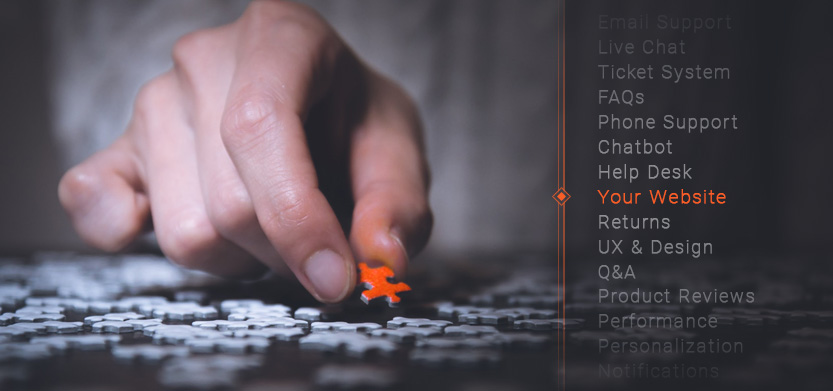
When it comes to customer service and ecommerce, we typically think of email and phone support, ticket systems, live chat, FAQs, etc. While these are all parts of an overall customer service strategy, what about the website itself?
Customer service starts with your website. Your website is often where customers interact with your store first and then continue to interact with you over time. It's the first layer of communication before anything else.
Customer experience is a competitive edge
Your products might not have any particular edge over competing websites selling similar (or the same) products, depending on what you're selling. How do you then gain a competitive advantage in the market? A couple of possibilities come to mind.
1. Your customer's experience

The customer experience (also commonly referred to as user experience or UX) involves everything a customer does when interacting with your website. User experience isn't only when buying your products, but the experience as a whole. So, customer experience is everything from site speed and performance, layout design and use of colours and margins, workflow for purchasing and returning products, user personalization, and so on. An extensive list of "things" makes up the overall customer experience.
Most ecommerce platforms and services follow a "best practice" approach, meaning that the platform has made an effort to get you started with the widely accepted standards that make up a good customer experience. There is a lot of good research that helps those of us in the industry determine those standards. Chances are, if you haven't explicitly targeted your customer's experience already, then you still have a solid foundation. However, this base can and should be, improved. Make your site the best it can be for your customers, and that alone will give you an edge over your competitors who have not.
2. Eliminate swivel chair processes
Eliminating manual processes isn't related to your customer's experience, but it's worth mentioning since we're talking about gaining an edge over your competitors. If your products don't separate you, your customer experience or business processes will.

I won't get into much detail since we have another post that dives into this topic. Still, a swivel chair process is a business process where you're manually entering operational data into multiple places. Automating these processes instead is a big step forward for ecommerce success. After all, automation saves time and therefore cost, allowing you to focus more on other aspects of your business such as marketing and your customer's experience.
Good customer experience is good customer service
When a customer reaches out to your customer service lines of communication, it's generally because they have an issue that needs to be resolved or is trying to get information about something. There will always be a need for traditional forms of customer service. Still, many issues can be eliminated or resolved in other ways by adapting your website to suit your customers better. Here are some examples.
Robust product pages
Make sure your product pages are robust and give your customers all of the information they need. Make it easy to understand what variations of the product are out-of-stock and give customers any information about when it will be back in stock. Include an on-page customer Q&A panel to ask questions about the product. It allows you or another customer to respond with an answer. Automatically engaging customers who previously purchased the item can be a valuable resource for customers who submitted Q&A.
Shipping and returns
Make your shipping and return policies easy to find and read. Go a step further and keep your customers up-to-date by sending status update notifications when fulfillment states have changed, including a shipment tracking number as soon as possible. Provide a self-serve return workflow that is easy for customers to use. If you also have physical stores, promote in-store returns alongside mailed return options.
Site performance
Invest in your underlying technology to make sure your site is fast. We're not patient creatures, so don't make your customers wait through agonizing load times. Ensure your server can handle the traffic that your website receives, especially during key shopping events, and ensure the underlying software for your site is modern and optimized.
Personalization
Personalize your customer experience by capturing your customer's personal information they provide and using that data in non-intrusive ways. Welcome them to your site by their first name, and use their name in email notifications and account pages if you know their first name. Provide customers with a list of recently viewed products so that they can easily find a product again when they're ready to buy. Likewise, provide relevant promotions and product suggestions when you start to understand their buying habits. Hint: All of this can be automated.
Learn from your other forms of customer service
As you start to improve your website's customer experience, make sure that whoever manages your other forms of customer service (email, phone, chat, etc.) is aware and ready to provide helpful feedback.
Put a plan in place to make sure that you understand the nature of each customer service request.
Gather as much information as you can and use it to improve your website and workflows. Prepare your customer service representatives with a set of meaningful questions that give insight into the customer interaction experience. Of course, if a customer is upset, then you may not want to push them into answering unrelated questions. Instead, listen to what they're upset about and try to understand the root cause. Ensure them that your company will make changes. If you can follow up and correct any issues your customers are having, these customers will appreciate your efforts. This type of follow-up and information sharing will improve every other customer's experience.
Try to eliminate customer service requests
The customer service requests you are receiving now can be quantified and tested against each improvement you make. Try understanding what type of request is most common and start with it. Engage your internal teams and your customers and find ways to positively impact that request. If successful, you'll see a drop in requests. Keep going until all of your customer service requests have been eliminated or reduced as much as possible.
The goal of this exercise is to gain repeat business from happy customers while at the same time reducing, or eliminating, your customer service requests. If you can do both activities, your company should achieve more product sales and reduced customer service costs. Happy customers also like to tell their friends and networks about their experiences. Ideally, the gains would pay for the investments made.
Get started
If you're unsure where or how to get started improving your customer's experience, we can help. Acro Commerce offers a proven method for getting results. We offer consulting services right through to implementation and launch, as little or as much as you need. Click below to learn more about our method.